

PESV is introducing the GTQ-BS03 gas detector for industrial and commercial facilities that need a configurable fixed point for continuous gas monitoring. The model brings sensing, local display, signal output, alarm relays, and field-oriented enclosure protection together for projects where a gas event needs to become a clear operational response.
The GTQ-BS03 is designed for industrial and commercial use. Its official product information lists combustible gas, toxic gas, oxygen, VOC, CO2, and Freon among the available measuring-gas options. That breadth lets project teams begin with the actual site hazard, then define the sensor and range that match the application rather than treating every gas-monitoring project as the same.
A Product Update for Multi-Scenario Gas Monitoring
PESV positions the GTQ-BS03 gas detector as an industrial and commercial fixed detector using a high-performance gas sensor, MCU technology, and SMT manufacturing. The published benefits include repeatability, measurement accuracy, stable performance, and long service life. Natural diffusion sampling makes it suitable for a defined monitoring point where the site design calls for permanent rather than portable measurement.
GTQ-BS03 at a Glance
- Industrial and commercial fixed gas monitoring
- Combustible gas, toxic gas, O2, VOC, CO2, and Freon options
- 4-20mA analog output or FBUS digital output
- Three relays: two free contacts and one active relay
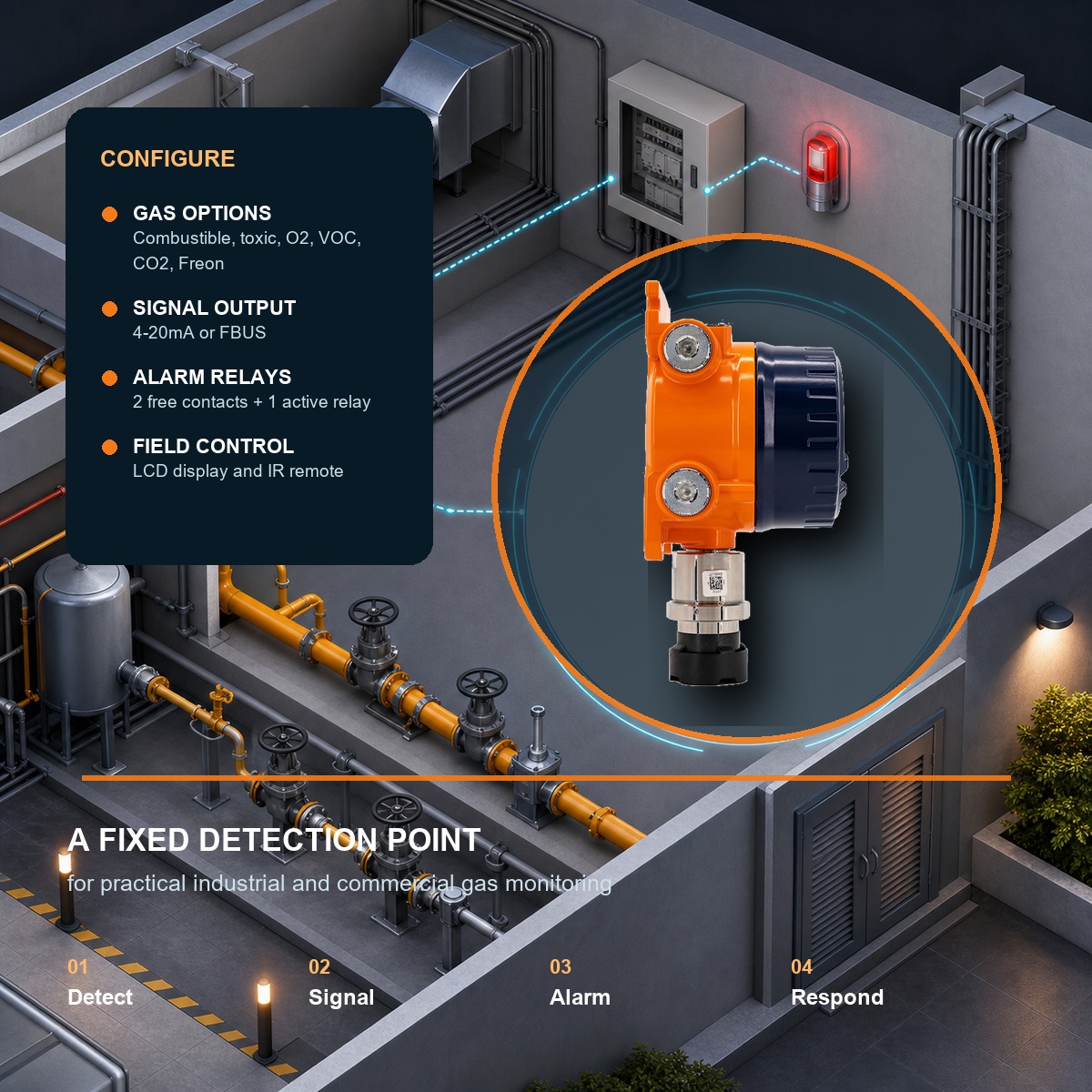
Output, Alarm, and Integration Options
For system integration, the official page lists 4-20mA analog output or FBUS digital output. This gives engineers a starting point for matching the detector with a compatible controller, PLC, BMS, or other project monitoring architecture. Output selection, cable routing, power supply, addressing, and the final control logic should be confirmed as part of the project design.
The GTQ-BS03 also lists three relay outputs: two free contacts and one active relay. A buyer can use that information to discuss staged alarm response, local sound-and-light alarms, ventilation, shutdown interface, or fault indication with the system integrator. The exact relay action and load must be selected, wired, and tested according to the site's approved safety design.
Designed for Clear Field Operation
A high-performance LCD screen provides local visibility, while the product page lists green power, red alarm, and yellow fault status indication. Infrared remote control enables non-contact operation for supported field tasks. These details matter during daily inspection because teams need a device that can be understood at the installation point as well as from the central monitoring system.
PESV also lists a smart sensor module described as calibration-free and easy to maintain. In real operation, every facility should still apply its own gas-specific bump-test, verification, calibration, maintenance, and documentation procedures. A well-defined maintenance plan remains essential to an effective gas safety program.
Published Configuration and Environment Data
| Item | Published GTQ-BS03 information |
|---|---|
| Sampling | Natural diffusion |
| Power | DC24V +/- 6V, no more than 3.0W |
| Response time | LEL T90 no more than 15s; toxic gas T90 no more than 30s; VOC/CO2/Freon no more than 15s |
| Outputs | 4-20mA or FBUS |
| Operation | Infrared remote control |
| Ingress protection | IP66/67 |
| Enclosure | Aluminum alloy; stainless steel optional |
The official specifications list a DC24V +/- 6V supply with power consumption no more than 3.0W, NPT3/4 cable entry, and a compact 130 x 154 x 95 mm enclosure. The aluminum-alloy version is listed at about 1.2 kg, with stainless steel optional at about 4.5 kg. These choices can be discussed when the project calls for a particular mounting method or corrosion-resistance preference.
Published environmental data includes IP66/67 ingress protection, humidity up to 95%RH without condensation, and ambient pressure from 86 to 106 kPa. The product page also lists explosion-protection information. Buyers should confirm the ordered sensor, enclosure, temperature class, certification, and local classified-area requirements before a final purchase decision.
What to Share When Requesting a Project Quotation
- Target gas and measuring range
- Application location and expected environmental conditions
- Required output: 4-20mA or FBUS
- Alarm, relay, controller, and interlock requirements
- Area classification, certification, enclosure, and installation needs
- Quantity, delivery destination, and project schedule
By sharing these conditions early, distributors, contractors, and facility teams can receive a more useful product recommendation and prepare a clearer installation plan. PESV can help buyers review the GTQ-BS03 gas detector, relevant fixed gas detector options, and compatible alarm or controller solutions for the intended project.
Explore the GTQ-BS03 Project Option
Visit the GTQ-BS03 product page, compare fixed gas detectors, or contact PESV for product selection and quotation support.