
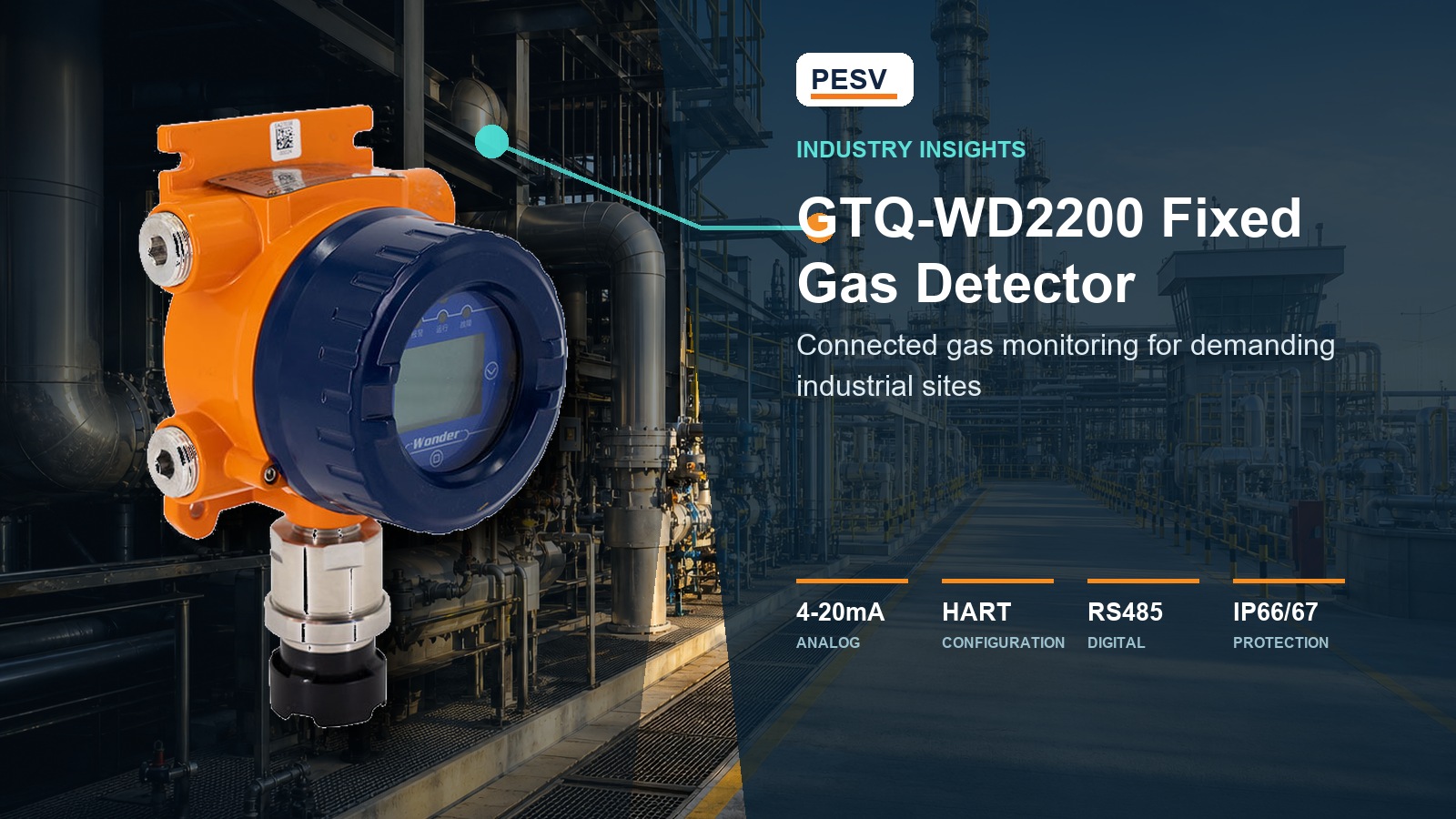
The GTQ-WD2200 fixed gas detector gives industrial project teams a practical route from continuous gas measurement to plant-wide alarm response. Designed for combustible and toxic gas monitoring, it combines local indication, multiple communication outputs, relay contacts, and a protected stainless-steel enclosure in one field instrument.
For petrochemical plants, gas facilities, process workshops, utility rooms, storage areas, and wastewater operations, detector selection is only the first step. A successful system also depends on the target gas, measuring range, mounting position, control architecture, alarm philosophy, and maintenance plan. This guide places the GTQ-WD2200 in that complete engineering context.
GTQ-WD2200 Fixed Gas Detector: Project Snapshot
PESV describes the GTQ-WD2200 as an industrial fixed detector built with a high-performance gas sensor, MCU technology, and SMT manufacturing. The published product information highlights repeatability, measurement accuracy, stable performance, and long service life. Natural diffusion sampling supports continuous monitoring at a selected fixed point without a sampling pump.
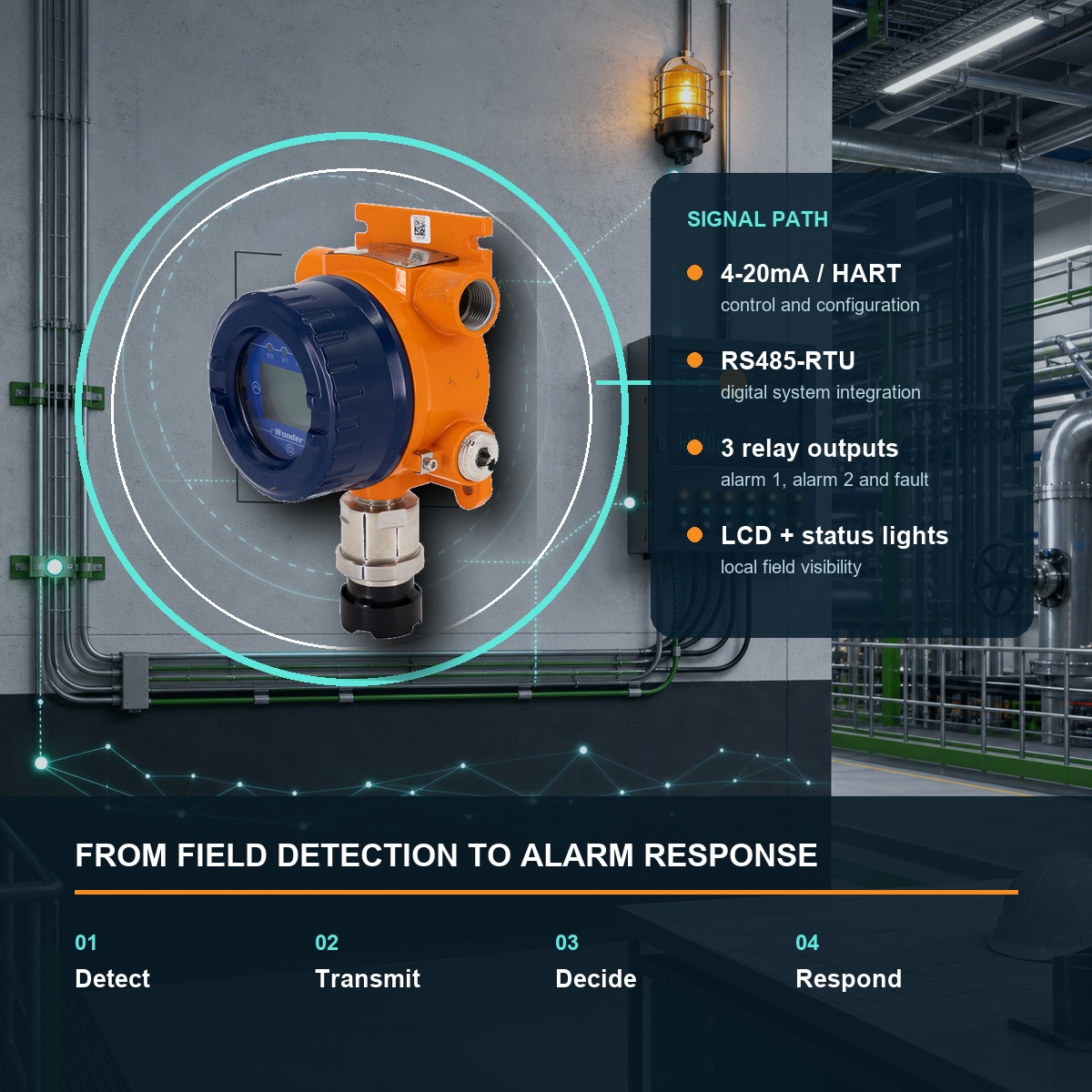
Its connection options are a central part of the product proposition. The detector provides 4-20mA analog output, RS485-RTU digital communication, and HART output. Three relays are assigned to first alarm, second alarm, and fault. These interfaces allow engineers to evaluate direct connection with a gas alarm controller, PLC, DCS, ventilation interlock, sound-light alarm, or other site response equipment.
From Gas Risk to Detector Configuration
Start with the hazard, not the model number. Confirm whether the monitored risk is combustible gas or a specific toxic gas, then define the required range, alarm thresholds, response objective, and applicable local standard. Gas density, airflow, release points, obstructions, temperature, and routine worker access all influence detector placement. A detector mounted in the wrong air path can produce a weak system even when the instrument itself performs correctly.
The published response time is T90 within 15 seconds for LEL measurement and T90 within 30 seconds for toxic gas measurement. Those values help project teams compare detection speed, but final acceptance should include the selected sensor, target gas, test method, cable route, controller logic, and the response of connected alarms or interlocks.
A Connected Signal Path for Industrial Monitoring
A 4-20mA loop is useful when a project needs a familiar analog signal with straightforward point-to-point integration. RS485-RTU can support digital communication where the system design calls for networked devices and structured data exchange. HART adds configuration and diagnostic possibilities over compatible infrastructure, and PESV states that a HART handheld communicator can be used for settings.
The relay contacts provide another layer of local integration. PESV lists SPST contacts rated 3A at 30Vdc or 3A at 250Vac for first alarm, second alarm, and fault. Before wiring, the integrator should verify whether each relay will drive an intermediate device or a final load, confirm fail-safe behavior, and document what happens during alarm, sensor fault, power loss, and maintenance bypass.
Field Operation and Maintenance Access
The GTQ-WD2200 fixed gas detector includes an LCD for local status and measurement review. State indication is published as green for power, red for alarm, and yellow for fault. Non-contact operation by magnetic bar or infrared remote control can reduce the need to open the enclosure during routine field work, subject to the site's approved operating procedure.
PESV also lists a smart sensor module, Bluetooth communication, and an optional remote-upgrade function. The product page describes the sensor module as calibration-free and easy to maintain; however, every operator should still follow the gas-specific bump-test, verification, calibration, recordkeeping, and replacement intervals required by the local safety program.
Published Technical Data at a Glance
| Selection item | Published GTQ-WD2200 data |
|---|---|
| Measuring gas | Combustible gas or toxic gas |
| Sampling method | Natural diffusion |
| Power | DC24V +/- 6V, no more than 3.0W |
| Response time | LEL T90 no more than 15s; toxic gas T90 no more than 30s |
| Electrical outputs | 4-20mA, HART, RS485-RTU |
| Relay outputs | First alarm, second alarm, fault |
| Ingress protection | IP66/67 |
| Enclosure / weight | Stainless steel / about 2.0 kg |
The enclosure is stainless steel with IP66/67 ingress protection, an NPT3/4 cable entry, and published dimensions of 130 x 209 x 116 mm. Approximate weight is 2.0 kg. The stated operating range is -40 to 70 degrees C for LEL and -20 to 50 degrees C for toxic gas, with humidity up to 95%RH without condensation and ambient pressure from 86 to 106 kPa.
Explosion-protection information on the official page includes II 2GD, Ex db IIC T6 Gb, and Ex tb IIIC T80 degrees C Db, with -40 degrees C to +60 degrees C ambient notation. Certification marks, gas type, temperature class, installation-zone requirements, and acceptance documents must be confirmed for the destination market and the exact ordered configuration.
Commissioning Checklist Before Handover
- Confirm the target gas, range, alarm thresholds, and local compliance requirements.
- Review the proposed mounting point against release sources, airflow, gas density, and maintenance access.
- Select 4-20mA, HART, RS485-RTU, and relay wiring according to the control-system design.
- Verify power, grounding, cable entry, enclosure protection, area classification, and controller compatibility.
- Challenge the detector with the approved test gas and confirm local display, controller reading, alarms, relays, and fault behavior.
- Record the baseline configuration and establish inspection, test, calibration, and sensor-replacement responsibilities.
A structured handover turns a detector purchase into an operating safety layer. The commissioning record should identify the detector tag, target gas, range, alarm values, output type, controller channel, relay actions, installation location, test gas, response result, and responsible personnel. It should also establish how future tests and maintenance events will be recorded.
When GTQ-WD2200 Is a Strong Project Fit
The GTQ-WD2200 is a useful candidate when a project needs fixed combustible or toxic gas monitoring, local visual status, several signal choices, dedicated alarm and fault relays, and an IP66/67 stainless-steel enclosure. Its approximately 2.0 kg published weight can also matter where mounting load and installation handling are part of the design review.
PESV can support distributors, EPC teams, plant operators, and industrial safety buyers in confirming the target gas, measuring range, output protocol, controller compatibility, accessories, and project documentation. Share the application conditions and required interfaces when requesting a quotation so the detector and the surrounding alarm architecture can be reviewed together.
Frequently Asked Questions
Which gases can the GTQ-WD2200 monitor?
The official product information lists combustible gas and toxic gas. The exact sensor, gas, range, and configuration should be confirmed when ordering.
Can it connect to a PLC or DCS?
The detector provides 4-20mA, HART, and RS485-RTU outputs. Compatibility, addressing, wiring, and system logic should be reviewed with the integrator before commissioning.
Is the GTQ-WD2200 suitable for outdoor industrial areas?
Its published stainless-steel enclosure and IP66/67 rating support demanding field use. The final decision must also consider certification, temperature, humidity, pressure, cable sealing, and the site’s classified-area requirements.
Discuss Your Gas Detection Project
Review the GTQ-WD2200 product page, browse fixed gas detectors, or contact PESV with your gas, range, output, certification, and application requirements.